About
The Journal of Data Economy and Governance (JDEG) is an interdisciplinary academic journal dedicated to advancing research on data as a core economic asset in the digital era. The journal focuses on the economic, institutional, and governance dimensions of data, aiming to establish a global platform for scholarly discourse on the emerging field of the data economy.
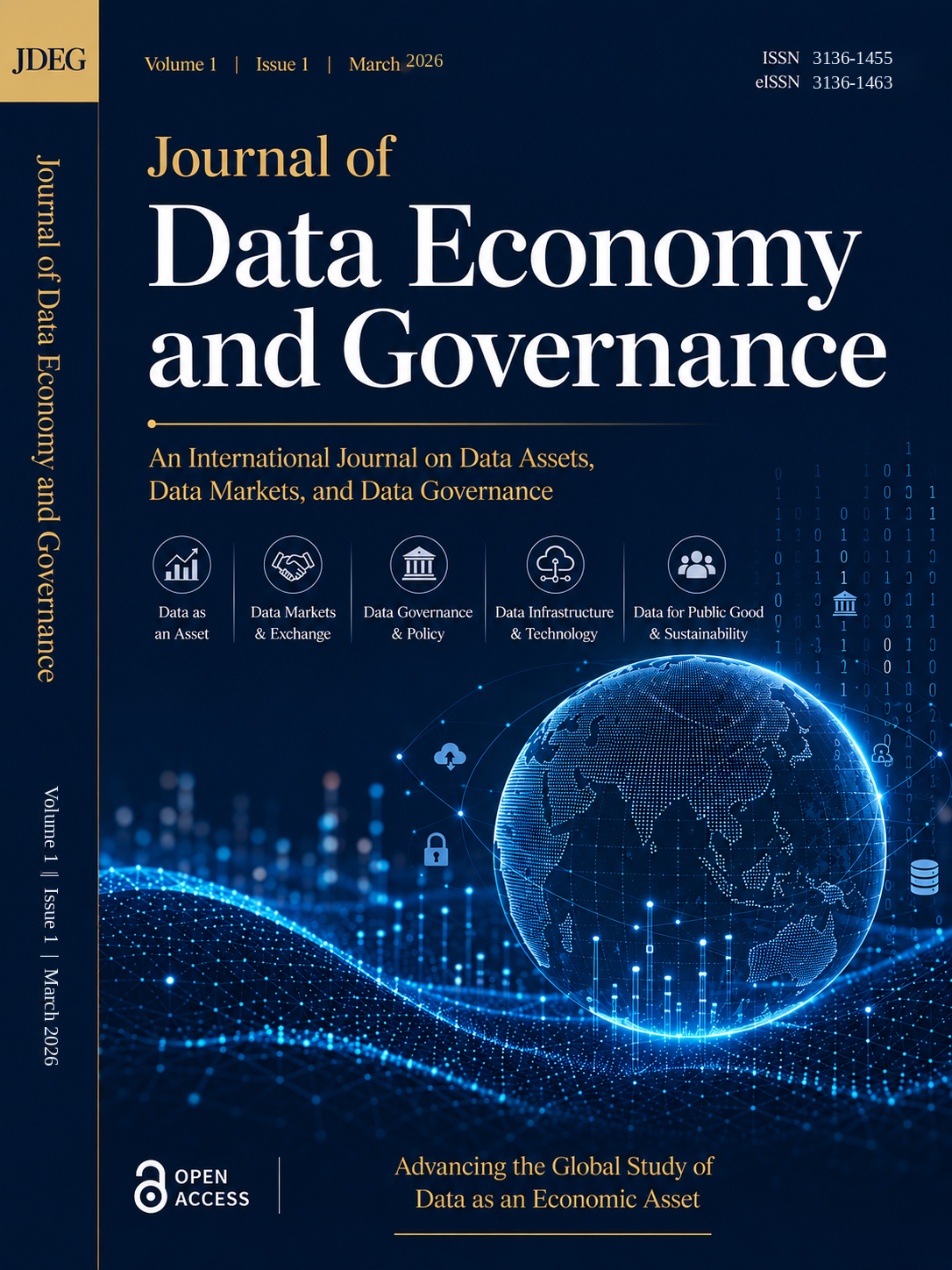
In contrast to traditional information systems or digital transformation journals, JDEG places data assetization, data markets, and data governance at the center of inquiry. It seeks to bridge economics, management, law, and information science, providing both theoretical insights and policy-relevant contributions.
Mission and Positioning
Data is becoming one of the most important factors of production in the digital economy. Questions concerning data rights, valuation, circulation, governance, and efficient allocation have become fundamental issues for governments, industries, and academic communities worldwide.
Despite the growing importance of data as a productive asset, systematic academic research on this subject remains at an early stage. There is still a clear need for a dedicated, high-quality scholarly platform that can connect theoretical inquiry, empirical evidence, institutional design, and policy-relevant analysis.
The Journal of Data Economy and Governance (JDEG) is founded to address this gap. The journal is committed to advancing rigorous research on the economic attributes, institutional arrangements, and governance mechanisms of data. It focuses on three closely related themes: data value creation, data markets, and data governance.
JDEG aims to build a global forum for scholarly dialogue in the emerging interdisciplinary field of the data economy. The journal welcomes contributions from economics, management, law, public policy, information systems, computer science, artificial intelligence, governance studies, and related fields.
Distinctive Focus
A distinctive feature of JDEG is its attention to China's institutional exploration and practical experience in the field of data as a factor of production. China is among the first major economies to explicitly recognize data as a production factor and to promote the market-oriented allocation of data resources at a systematic level.
China has accumulated early institutional experience in areas such as data governance, public data opening, data market development, data infrastructure, and data circulation mechanisms. These practices are significant not only for China's domestic digital transformation, but also as a comparative reference for global research on data markets and data governance.
JDEG seeks to place these developments within an international academic context. The journal encourages scholars to examine, theorize, and critically evaluate practical experiences from China and other regions, thereby promoting international knowledge exchange and mutual learning.
Aims and Scope
JDEG welcomes original research articles, empirical studies, theoretical contributions, comparative analyses, case studies, and high-quality policy-oriented papers related to the following core areas.
1. Data as a Factor of Production and Data Value Creation
· Data as a factor of production
· Market-oriented allocation of data resources
· Data valuation, value realization, and value distribution
· Economic analysis of data-driven production
2. Data Markets and Transaction Mechanisms
· Data trading platforms and market design
· Data pricing strategies and incentive mechanisms
· Data circulation, interoperability, and exchange standards
· Platform economy, data monetization, and data-based business models
3. Data Governance and Institutional Design
· Data governance frameworks, architectures, and operating models
· Data rights, data property arrangements, and ownership models
· Data policy, regulation, compliance, and accountability
· Cross-border data flows, data sovereignty, and international coordination
4. Data Infrastructure and Enabling Technologies
· Privacy-preserving data circulation and data sharing
· Construction, operation, and governance of data infrastructure
· Data platforms, data ecosystems, and trusted data environments
· Technical and institutional foundations for secure and efficient data use
5. Applications and Social Impact
· Industrial data, sectoral data, and data-driven production systems
· Public data, digital government, and public-sector data governance
· Data for sustainable development, public interest, and social value
· Socioeconomic impacts of data-driven transformation
6. Data and Artificial Intelligence
· Mutual reinforcement between artificial intelligence and data
· AI-enabled data value creation and data utilization
· Data supply, data quality, and data governance for AI systems
· Coordination between data governance and AI governance
Article Types
The journal welcomes a range of scholarly and policy-relevant contributions, including but not limited to:
· Original research articles that make theoretical, empirical, or methodological contributions
· Comparative studies of data governance systems, data market institutions, and regulatory approaches
· Policy analyses and institutional design papers with clear academic grounding
· Case studies of data markets, public data initiatives, data exchanges, and data infrastructure
· Review articles that synthesize emerging debates in the data economy and governance field
Intended Readership and Contribution
JDEG is intended for scholars, policymakers, regulators, industry practitioners, platform operators, data infrastructure builders, and professionals engaged in the governance and economic use of data. By bringing together interdisciplinary research, the journal aims to support the development of a more coherent body of knowledge on data as a productive resource and governable asset.
The journal encourages submissions that connect conceptual innovation with institutional relevance. It is particularly interested in research that can clarify how data creates value, how data markets can be designed and governed, and how public and private actors can build trustworthy mechanisms for data circulation, sharing, and responsible use.
Contact
Principal Contact: Prof. Qun Tu, tuqun@buct.edu.cn
Support Contact: Technical Editor, jdeg@sc-press.com